
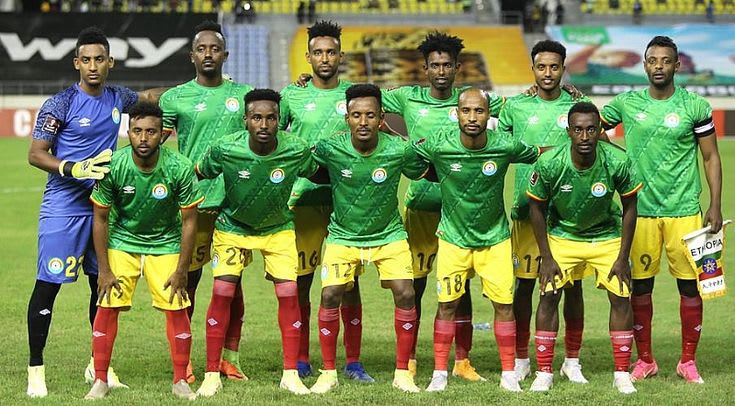
Ethiopia has officially entered the race to host the 2028 Africa Cup of Nations, more than 50 years after it last welcomed Africa’s biggest football tournament.
The Ethiopian Football Federation announced on Monday, August 24, 2026, that it had formally submitted its bid to the Confederation of African Football, CAF. The proposal is backed by the Ethiopian government and includes the official bid handbook required for the hosting process.

In its announcement, the Ethiopian Football Federation said: “Ethiopia has formally submitted its bid to CAF to host AFCON 2028.” The federation added that the bid was backed by the Federal Democratic Republic of Ethiopia and that the submission addressed CAF's requirements while reaffirming the country's readiness to host the tournament.
The move represents an important moment for Ethiopian football. The country has a long relationship with the Africa Cup of Nations, having hosted the competition three times in 1962, 1968 and 1976. However, it has not hosted the tournament since 1976. CAF itself has noted that the 2027 edition, which will be staged by Kenya, Tanzania and Uganda, will mark AFCON's return to East Africa for the first time since Ethiopia hosted the competition in 1976.
Ethiopia's first hosting of the tournament in 1962 was particularly memorable because the country also won the competition on home soil. It defeated Egypt, then known as the United Arab Republic, 4–2 after extra time in the final to claim its only AFCON title.
More than six decades later, Ethiopia is seeking to bring the continental showpiece back to the country.
The decision comes after CAF opened the bidding process for the 2028, 2032 and 2036 editions of the Africa Cup of Nations. On July 3, 2026, CAF officially invited its 54 member associations to submit bids for the tournaments. The football governing body said it had developed a bidding framework designed to provide a transparent and credible process for selecting the hosts.
CAF also confirmed that the 2027 AFCON will be held jointly by Kenya, Tanzania and Uganda from June 19 to July 17, 2027. That tournament will be the first AFCON to be jointly hosted by three countries.
Ethiopia's bid therefore comes at an interesting time for East African football. If the country succeeds, the region could host the competition in successive editions, with the 2027 tournament already scheduled for Kenya, Tanzania and Uganda.
But while Ethiopia has a strong football history, its bid also faces some major challenges.
One of the biggest concerns is infrastructure.
Hosting a 24-team AFCON requires several stadiums that meet CAF's standards, as well as suitable training facilities, accommodation, transportation, medical services, security and other supporting infrastructure.
Ethiopia's current football infrastructure has been a concern even for its national team. Reports have noted that the country has had difficulties providing enough CAF-approved stadiums, forcing the Ethiopian national team to play some of its home matches outside the country.
The country is, however, working to change that situation.
A major part of the government's plans is the development of new and upgraded sporting facilities, particularly in Addis Ababa. The planned Addis Ababa International Stadium is expected to become one of the country's major sporting venues and could play an important role if Ethiopia's bid progresses successfully.
The Bahir Dar International Stadium is also among the country's important football facilities. Recent reports have identified the stadium as one of the venues being upgraded to meet higher CAF requirements.
For Ethiopia, the AFCON bid is therefore about more than football. It is also an opportunity to accelerate investment in sporting infrastructure and demonstrate the country's ability to organise a major international event.
There is also a strong political and national element to the bid.
The Ethiopian Football Federation has made it clear that the proposal has government backing. Earlier reports also indicated that the Ethiopian government was prepared to provide a sovereign guarantee for the hosting project, showing that the bid is being treated as a national project rather than simply an initiative of the football federation.
Ethiopia's location could also give the bid an interesting advantage. Its capital, Addis Ababa, is home to the headquarters of the African Union, giving the country a particularly strong connection to continental institutions and African diplomacy.
However, the country will still have to convince CAF that it can meet the practical demands of hosting one of Africa's largest sporting events.
Security will be another important consideration. Ethiopia continues to face security challenges in parts of the country, including unrest and armed conflicts in some regions. Any assessment of the country's bid will therefore have to consider whether players, officials, supporters and visitors can be guaranteed adequate safety throughout the tournament.
There is also a difference between submitting a bid and winning the hosting rights.
Ethiopia's announcement on August 24 means that the country has formally entered the competition. It does not mean CAF has selected Ethiopia as the host.
CAF said in a recent update that the bidding process for the 2028, 2032 and 2036 tournaments was progressing and that “numerous exciting bids” had been submitted. The organisation said announcements would be made in due course.
This means Ethiopia will have to wait for CAF's evaluation before knowing whether its effort has succeeded.
For Ethiopian football supporters, however, the bid itself is already significant.
The country has not hosted AFCON since 1976, when it staged the tournament more than five decades ago. Since then, African football has changed considerably, with the competition expanding, becoming more commercially valuable and attracting a much larger global audience.
CAF said in July that AFCON has more than 3.2 billion television viewers and six billion digital views globally, underlining just how important the competition has become.
Hosting such an event could therefore bring significant international attention to Ethiopia while creating opportunities for tourism, hospitality, transport, business and sports development.
It could also give Ethiopian football a much-needed boost.
The national team has struggled in recent years, while the country's football infrastructure has lagged behind some of the continent's leading football nations. Hosting AFCON could provide an incentive to invest more heavily in stadiums, academies, training facilities and other parts of the football system.
But before any of that can happen, Ethiopia must first convince CAF that its plans are realistic and achievable.
For now, the country's message is clear: Ethiopia wants AFCON back.
The formal submission on August 24, 2026, has opened another chapter in the country's long relationship with African football. Whether that chapter ends with Ethiopia being selected as the 2028 host will depend on CAF's evaluation of its facilities, infrastructure, security arrangements and overall readiness.
What is certain is that after more than 50 years, Ethiopia has once again placed itself at the centre of the conversation about hosting Africa's biggest foot
ball tournament.
© 2026 Aliu Azeema |
TalkAfricang.com


Comments (0)
Leave a Comment