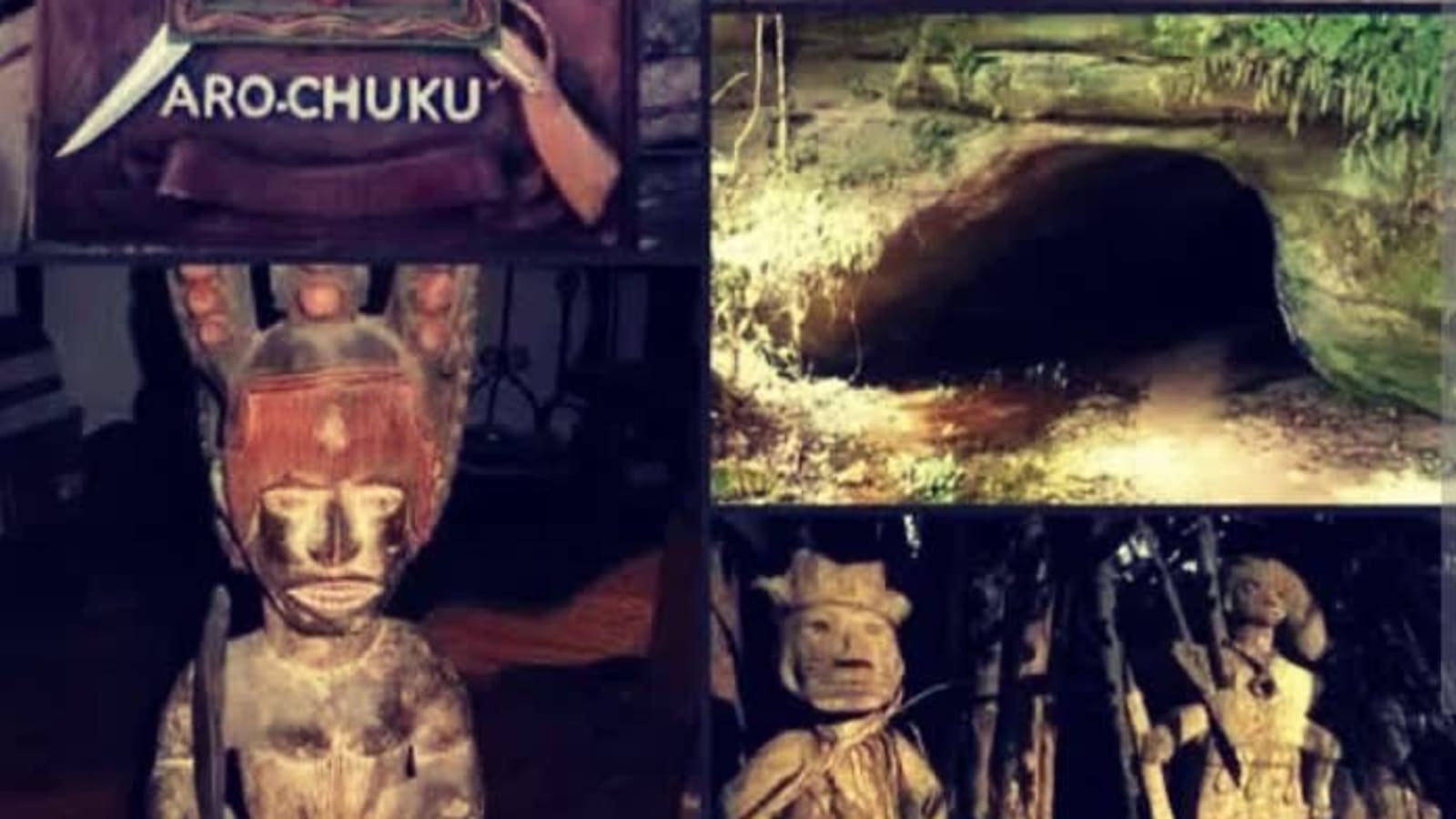
The Arochukwu Long Juju Slave Route is not just a historical pathway; it is a psychological corridor of power, fear, and lost freedom. Located in present-day Arochukwu, Abia State, this route formed part of the machinery that sustained one of West Africa’s most feared religious institutions—the Ibini Ukpabi, popularly called the Long Juju Oracle. What began as spiritual consultation often ended as human disappearance. 
Historically, the oracle functioned as a supreme court in pre-colonial Igboland and beyond. People from distant communities came seeking justice, truth, or divine verdicts. But the system was rigged. Those pronounced “guilty”—often through manipulation—were secretly diverted away from the sacred grounds. Instead of redemption, they were led through dense forests, rocky tunnels, and narrow paths: the Long Juju Slave Route. From there, captives were transferred to coastal networks and sold into the transatlantic slave trade.
The Aro Confederacy understood power the old-fashioned way—control the story, control the people. Religion became law; fear became enforcement. The brilliance and brutality lay in disguise. Victims believed the oracle had swallowed them, when in truth, commerce had claimed them. No public violence. No resistance. Just silence. Efficient. Chilling.
Culturally, the route stands today as a mirror. Stone steps, caves, shrines, and forest trails still breathe memory. For the Igbo people and Africans at large, it forces an uncomfortable truth: not all chains came from outsiders. Some were forged at home, polished with tradition, and justified with belief. Arochukwu is therefore not only a site of pain but of reckoning—a call to interrogate power, question systems, and protect truth.

The Long Juju Slave Route teaches this final lesson plainly: history does not vanish—it waits. And when we walk these paths today, we are not tourists. We are witnesses, carrying forward the duty to remember, to tell it straight, and to ensure that no belief, no matter how sacred, is ever again used to erase a human life.
© 2026 Ikeun Divine Michael | TalkA
fricang.com


Comments (0)
Leave a Comment