
For most of the last century, the world learned about Africa from people who did not live there. The stories arrived in a handful of familiar shapes: famine, war, rescue, and the occasional safari. Africans appeared in them as subjects, rarely as narrators. Even today, a child in Houston or Hamburg is more likely to meet the continent through a charity advert than through a joke told by someone who grew up eating jollof at a family party.
That is the gap the One54 podcast walked into. Its name is a quiet argument in itself: the African Union recognises 54 countries, and the show’s motto promises to celebrate all of them, one story at a time. The ambition is large, the format is simple, and the effect, as this article argues, is to move the microphone into African hands.
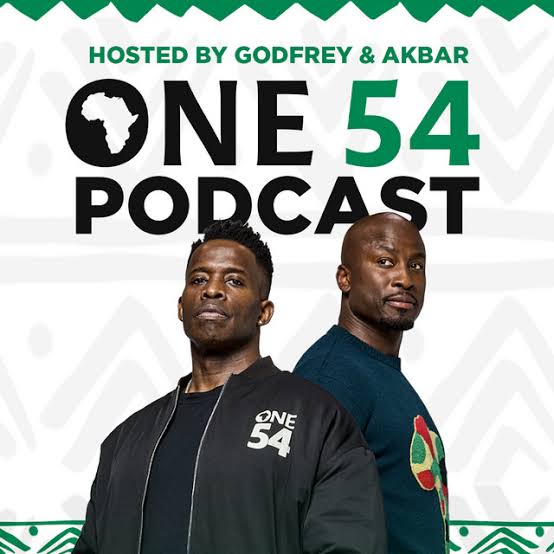
Godfrey Daneschmah and Akbar Gbajabiamila.
Two hosts, one living-room register
One54 is hosted by Akbar Gbajabiamila and Godfrey Daneschmah. Akbar is a former NFL player and television host, best known for co-hosting American Ninja Warrior and CBS’s The Talk. Godfrey is a comedian and actor whose career spans more than thirty years, known for sharp impressions and high-energy stand-up. Both draw openly on their Nigerian heritage.
This choice of hosts matters more than it first appears. Neither is a diplomat, an academic or a development expert, the figures who have traditionally been invited to “explain” Africa. They are entertainers, and they talk the way families talk: interrupting, teasing, comparing food. When guests sit down with them, there is no lecture to survive. The conversation is allowed to be funny first and serious second, which is often the more honest order.
The show is distributed through iHeartPodcasts and releases weekly, which gives it something African media has often lacked abroad: mainstream American podcast infrastructure carrying African-centred conversation as a regular, expected appointment rather than a special-occasion feature.
A guest list that works like a map
The strongest evidence of what One54 is doing sits in its guest list, which refuses to reduce Africa to one profession or one country.
Drea Okeke, a Nigerian-American creator and comedian named to the Forbes 30 Under 30 list, came on to talk about building a global audience. Her viral Nigerian slang series has taught viewers in Japan, South Korea, Mexico and Italy about Nigerian culture, and she spoke about being bullied for her accent as a child and how social media now lets Africans reshape the picture of the continent themselves. Chinedu Unaka, known for Abbott Elementary and Insecure, spoke about growing up as the child of Nigerian immigrants, embracing his Igbo identity, and the small daily indignities of having his name mispronounced by teachers, baristas and comedy hosts.
The range keeps widening. Chef Marcus Samuelsson discussed Ethiopia, racism and building a global food empire. Olympia champion Samson Dauda, who rose from Nigeria to the United Kingdom, spoke about discipline and identity. Navy SEAL Remi Adeleke told the story of moving from a comfortable Nigerian childhood to poverty in the Bronx and his fight against corruption. Journalist Joy Reid explored her Congolese roots and the global influence of Black American culture, while examining how slavery tried to erase African identity.
Sport, food, comedy, military service, media and scholarship: in one feed, Africa is shown to be a source of every kind of excellence, not a single story.
Most recently, the hosts sat down with Princeton scholar Eddie Glaude Jr., and the conversation turned to the history and politics of the relationship between Africans and Black Americans. The episode shows how far the show has grown beyond celebrity chat into real intellectual territory. Before the cameras rolled, the hosts handed their guest Vida Malt and chinchin, two Nigerian staples, and his reaction to the cookie-like snack was the kind of small, human moment the format thrives on.
Humour as a passport
Stereotypes rarely die by argument. They die by familiarity. A joke that lands in Lagos and in Los Angeles at the same moment does more work than a policy paper. When Godfrey joked about needing a pamphlet on how to be Nigerian, reflecting on how often he was corrected as a child for receiving things with his left hand, the clip travelled far enough to be reported in the Nigerian press. The unwritten rules of respect that Nigerian children absorb without ever being formally taught became a shared, affectionate laugh across two continents.
This is how cultural export works at its best. It does not ask the world to feel sorry for Africa or to admire it from a distance. It invites the world in to laugh at the same family rules that Africans themselves grew up laughing about.
The diaspora’s second act
The show describes itself as exploring the culture clashes of growing up African in America. That framing quietly changes who gets to be called African. For decades, the diaspora was spoken about as if it stood outside the continent’s story: too American to be African, too African to be American. One54 treats that in-between space as a place with its own stories worth telling.
Listen to the recurring themes: the first-generation child carrying the weight of immigrant expectations; the mispronounced name; the pressure to choose academics over athletics; the feeling of being fully American and fully Nigerian at once. These are not footnotes to African life. They are the continuing chapters of it, written abroad, and they deserve the same seriousness as stories told at home.
There is also a bridge being built. By featuring guests from Ethiopia, Nigeria and the Congo, and by hosting honest conversations about the tension between Africans and Black Americans, the show offers the diaspora a map back to the continent and offers the continent a window onto the diaspora. In a media landscape that often keeps these audiences apart, that is a significant act of connection.
Why telling our own story matters
The politics of who narrates is not a small matter. A story told by outsiders tends to be shaped by outsiders’ needs: to raise funds, to justify intervention, to satisfy curiosity. A story told by insiders is shaped by recognition. It includes the humour, the food, the quarrels, the ambition and the contradictions that make a people real.
One54 sits within a larger movement of African voices taking the microphone. Creators on social media, filmmakers, musicians and podcasters are collectively rewriting the global image of the continent. What distinguishes One54 is that it does this through long-form conversation, a format that rewards nuance. A guest has time to be contradictory, to be vulnerable, to say something that does not fit on a poster.
Questions for the next chapter
Influence of this kind should also be examined honestly. The guest list so far leans heavily toward Nigerian and Nigerian-American voices, which is understandable given the hosts’ own background, but a show named for 54 countries will eventually be measured against all of them. Francophone, Lusophone and North African stories, along with voices from within the continent and not only from the diaspora, would give the promise in the title its full weight.
There is also the question of audience. Does the show reach listeners who are not already invested in African culture, the ones whose first image of Africa is still the old one? The hosts are clearly aware of the opportunity: the team has announced a live 154 show for January 28, 2027 in Santa Monica, alongside a fashion presentation and food, and is building a merchandise line that carries the slogan of one continent and 54 countries. Moving from audio into live experience and consumer culture suggests a brand that intends to be a lasting cultural presence, not a passing feed.
Conclusion
The most radical thing One54 does is ordinary. It lets Africans, at home and abroad, talk about their lives in their own voices, with their own jokes, to an audience that is listening. That, more than any statistic, is the measure of its impact on African storytelling worldwide: it normalises the idea that the continent is not a topic but a conversation, and that the people in it are fully entitled to lead it.
For African media houses and storytellers on the continent, the lesson is both an encouragement and a challenge. The world is ready to hear us. The question now is how many more of us will pick up the microphone.

Comments (0)
Leave a Comment