
$46 billion. Two mega-refineries. A cement empire in 14 countries. Africa's richest man just laid out the most audacious industrial bet the continent has seen in a generation — and for once, the ambition has the numbers to back it.
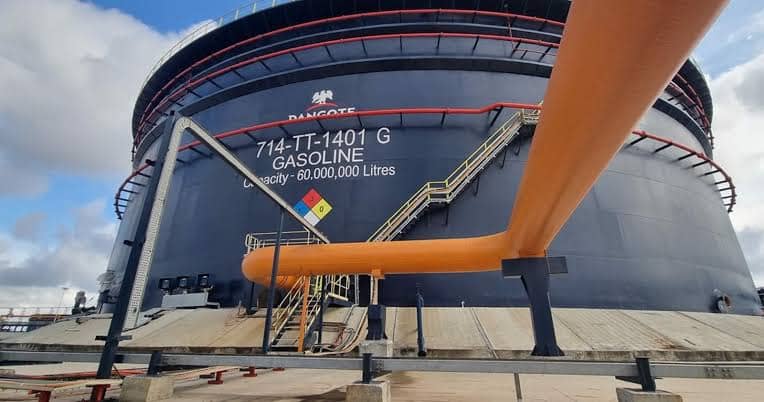
A gasoline storage tank at the Dangote Petroleum Refinery in Lagos. (Photo: Dangote Refinery / press archive — credit as reported by Africa Briefing; Bloomberg has separately credited similar refinery imagery to photographer Benson Ibeabuchi)
Let's get the number out of the way first, because it deserves to sit there uncomfortably for a second: $46 billion. That's what Dangote Industries has committed to spend between 2026 and 2028 — not over a decade, not as an aspiration, but as a stated, three-year investment programme spanning refining, cement, and fertiliser. It's the kind of figure that usually belongs to a national budget, not a single privately-controlled African conglomerate. And it's on top of the $20 billion already sunk into the Lagos refinery alone.
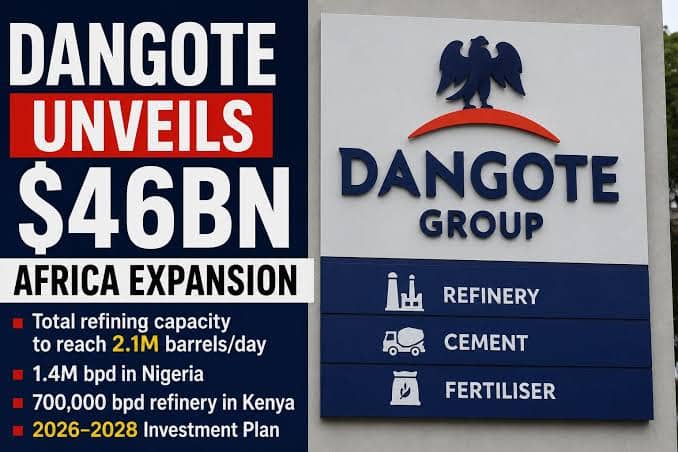
Dangote Group's $46 billion expansion plan, as summarised across African business press coverage in July 2026. (Graphic: widely circulated in coverage of the announcement; original creator unconfirmed)
THE PLAN, IN NUMBERS THAT ACTUALLY MEAN SOMETHING
Group revenue currently sits at roughly $20 billion. The stated target: $80 billion within three years, then $100 billion by 2030 — a fivefold jump, confirmed for the first time by group executive director Fatima Dangote in a Bloomberg interview. The financing isn't vague either. It rests on three concrete pillars: a Dangote Refinery IPO on the Nigerian Exchange, expected around August 2026 and already being called Africa's largest-ever public listing, valued anywhere from $39 billion to $50 billion; a stake sale in the fertiliser business tied to a separate $7 billion expansion backed by the Africa Finance Corporation; and a secondary Dangote Cement listing on the London Stock Exchange.
Then there's the refining ambition itself, which has quietly become continental in scope. Nigeria's facility, already the world's largest single-train refinery at 650,000 barrels per day, is being expanded to 1.4 million bpd. During performance testing in June 2026, it briefly exceeded even that, processing more than 700,000 barrels in a day — ahead of its own design capacity. Now add Kenya to the map: Dangote Industries has confirmed plans for a 700,000-barrel-per-day refinery, most likely sited near Mombasa or Lamu, intended to serve Kenya, Tanzania, Uganda, and South Sudan. Combined, Nigeria and Kenya alone would give Dangote 2.1 million barrels per day of refining capacity — a privately-owned network larger than what most oil-producing nations control through their state companies.
THIS ISN'T JUST ABOUT DANGOTE'S BALANCE SHEET
Here's the part worth sitting with: Africa currently refines only about 44 percent of the petroleum products it consumes, despite being a net crude exporter, according to a 2022 African Union assessment. That's the paradox this whole strategy is aimed at — a continent that pumps oil out of the ground and then buys back the fuel refined from it, at a markup, from someone else. Kenya's government clearly sees the same logic: President William Ruto has committed Ksh 21.5 billion in seed capital toward the proposed refinery, describing it as protection against exactly the kind of global supply shock that hit East African fuel prices hard in recent years.
The fertiliser side tells the same story with a different crop. Africa holds roughly a quarter of the world's uncultivated arable land, yet remains dependent on imported fertiliser — a vulnerability recent global supply chain disruptions have made painfully visible. Dangote's response: a $7 billion push to triple Nigerian urea and ammonia capacity and build an entirely new fertiliser platform in Ethiopia, backed by a separate $4.2 billion, 25-year gas supply deal with China's GCL Group — reportedly set to become East Africa's largest urea complex.
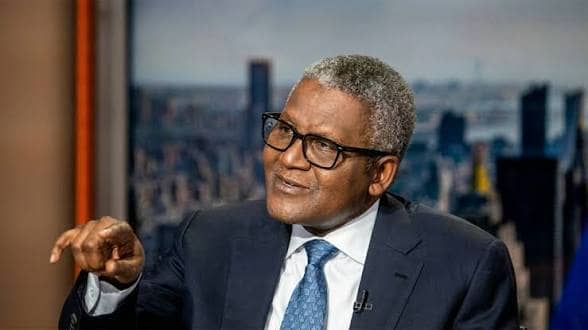
Aliko Dangote in a televised interview discussing the group's expansion strategy. (Photo: Bloomberg Television — matches Bloomberg's coverage of the $100 billion target interview)
THE CEMENT EMPIRE NOBODY TALKS ABOUT ENOUGH
While the refinery gets the headlines, Dangote Cement has quietly built the kind of continental footprint most multinationals would envy: 55 million tonnes of annual capacity across plants in roughly 14 African countries, from a new Ivory Coast facility that began production in late 2025 to expansion projects in Ethiopia and a fresh $1 billion commitment in Zimbabwe covering cement, power generation, and a proposed 2,000-kilometre petroleum pipeline linking Namibia to Zimbabwe. The London listing is meant to give this sprawling, already-profitable business the kind of international investor access a purely Lagos-listed stock structurally can't command.
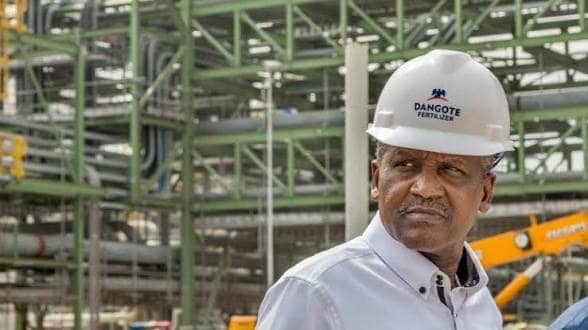
Aliko Dangote touring a fertiliser plant construction site. (Photo: Dangote Fertilizer / press image — exact original outlet unconfirmed, recommend verifying before final publication)
THE PART THAT DESERVES A LITTLE SKEPTICISM
None of this is a sure thing, and it's worth saying so plainly rather than treating a press release as a done deal. The original Lagos refinery took nearly a decade and blew past its budget before it processed a single barrel. A fivefold revenue jump in five years, financed partly by naira-exposed listings in a country where currency volatility has repeatedly punished even Dangote's existing cement business, is an aggressive bet by any standard. Analysts have already flagged margin pressure risk in the cement division from regulatory shifts and FX instability. The Kenya refinery, notably, doesn't have a confirmed site yet — the project shifted once already from a planned Tanzania location, and 'most likely near Mombasa or Lamu' is not the same thing as a groundbreaking.
But the difference between this and the usual big-number African infrastructure announcement that quietly disappears a year later is that pieces of this are already operational and generating cash — the Lagos refinery is real, it's running, and per the Economist Intelligence Unit it was supplying nearly 80 percent of Nigeria's domestic petrol demand as of April 2026. That's not a pitch deck. That's a fuel pump.
WHY THIS MATTERS BEYOND ONE MAN'S FORTUNE
Strip away the billionaire-profile framing for a second and what's left is a genuinely continental industrialisation story: a refining network stretching from Lagos to Mombasa, a fertiliser platform tying Nigeria to Ethiopia, cement plants from Abidjan to Harare, and an IPO that Nigeria's own exchange is calling a test of whether African capital markets can host transactions this large without leaning on London or New York. Whether or not Dangote hits $100 billion on schedule, the infrastructure being built in the attempt — refineries, fertiliser plants, pipelines, ports — doesn't disappear if the timeline slips. That's the real bet here, and it's a bigger one than any single man's net worth.
© 2026 Abdulmumin Ishola Olaleye | TalkAfricang.com

Comments (0)
Leave a Comment