Tension in Anambra as Soludo Clamps Down on Sit-at-Home, Shuts Onitsha Market

Tension in Anambra as Soludo Clamps Down on Sit-at-Home, Shuts Onitsha Market

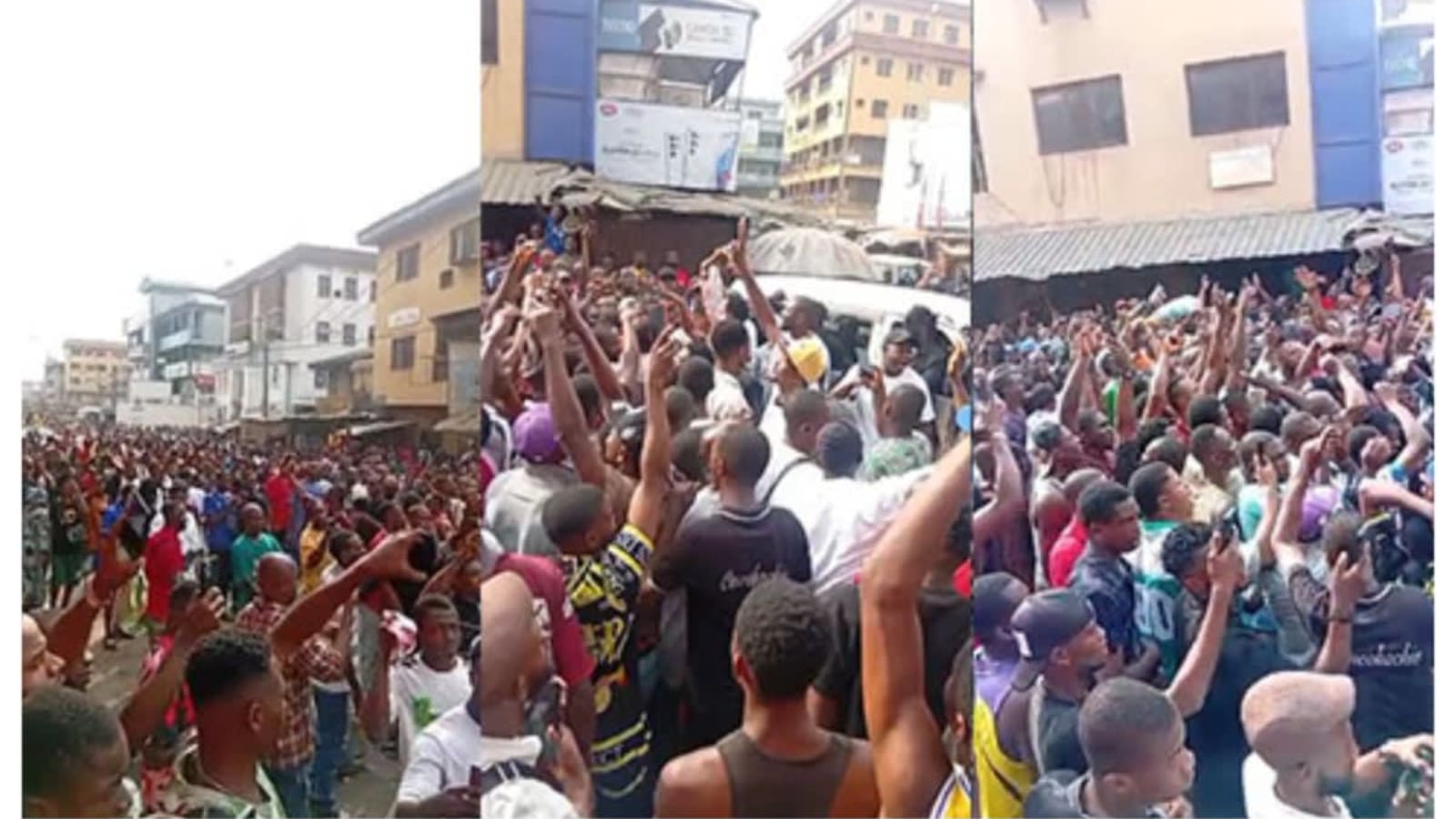
Protests erupts at the popular Onitsha Main Market in Anambra State following the decision of Governor Chukwuma Soludo to shut down the market for one week over traders’ failure to comply with the state government’s directive against the sit-at-home practice.

The development follows Governor Soludo’s continued opposition to the sit-at-home observance, which is traditionally observed on Mondays across many parts of South-East Nigeria. The sit-at-home practice, initially enforced by separatist groups, has also been embraced by many residents as a symbolic act of remembrance for Igbo heroes, soldiers, and civilians who lost their lives during the Nigerian Civil War.

While the practice persists in several South-Eastern states, it has largely ceased in Awka, the Anambra State capital, where schools, markets, and businesses now operate fully on Mondays. Governor Soludo has repeatedly stated that Anambra State will no longer tolerate sit-at-home, describing it as an act of economic sabotage that hurts traders, workers, and the overall growth of the state.

According to reports, the governor visited Onitsha Main Market and expressed displeasure after discovering that commercial activities were largely shut down on a Monday. As a result, he ordered the closure of the market for one week as a warning to traders, insisting that all economic activities must resume fully on Mondays.

The situation escalated on Tuesday when traders who were unaware of the new directive arrived at the market, only to be turned back by security operatives enforcing the shutdown. This sparked outrage among traders and youths, leading to protests within and around the market premises.

Governor Soludo has since issued a further warning, stating that if traders continue to observe sit-at-home in defiance of government orders, the market could face additional shutdowns, including a possible indefinite closure. He reportedly warned that continued disobedience would attract even harsher measures.

As tensions remain high, residents and traders await further developments, with many calling for dialogue between the government and stakeholders to prevent further economic disruption in the state.
Filed under: politicsnews

Share this article

Keep Reading

More stories you might find interesting

Taiwo Oyedele Dismisses ₦80 Trillion Borrowing Claim, Defends Tinubu's Fiscal Record
news

Taiwo Oyedele Dismisses ₦80 Trillion Borrowing Claim, Defends Tinubu's Fiscal Record

Chairman of the Presidential Committee on Fiscal Policy and Tax Reforms, Taiwo Oyedele, has dismissed claims that President Bola Ahmed Tinubu's administration borrowed ₦80 trillion, describing the widely circulated figure as false and based on a misunderstanding of Nigeria's public debt data. Oyedele made the clarification on Monday, July 20, 2026, during an economic review session organised by the Senate Committee on Finance, where lawmakers examined the country's fiscal position and debt profile.

NIGERIA'S STOCK MARKET IS NOW THE BEST-PERFORMING IN THE WORLD
news

NIGERIA'S STOCK MARKET IS NOW THE BEST-PERFORMING IN THE WORLD

Bloomberg data confirms the NGX has overtaken South Korea's Kospi to lead all 92 global exchanges tracked this year, driven by financial-services stocks, FX reforms, and a pending frontier-market upgrade Photo: Premium Times — Stockbrokers on the trading floor of the Nigerian Exchange, Lagos Nigeria's stock market has become the best-performing equity market in the world in dollar terms, according to Bloomberg data tracking 92 global exchanges. The Nigerian Exchange (NGX) benchmark index has returned 67 percent year-to-date, narrowly ahead of South Korea's Kospi at 66 percent the previous global leader.

THE CHANGE WE AREN'T READY FOR
politics

THE CHANGE WE AREN'T READY FOR

Everyone wants a better Nigeria. But what if Nigeria is waiting for us first? At every gathering — weddings, WhatsApp groups, church meetings — Nigerians recite the same grievances: failed promises, stolen budgets, roads that vanish after one rainfall. We are fluent in complaint. But here is the harder question: if Nigeria became, overnight, the nation we say we want, would our own daily habits be worthy of it — or would we quietly rebuild the dysfunction we just escaped? This is not an attempt to excuse bad governance or shift responsibility from those in power, it is a move to confront the uncomfortable truth. Nigeria's greatest problem may not be the government alone, It may also be Nigerians — all of us, in the small choices we make when no one is watching.

Comments (0)

Leave a Comment

0/1000
Loading comments...