
A post circulating on Instagram asks how a Nigerian home can stay cool in 95-degree heat without air conditioning. The answer, developed by the architect Demas Nwoko over more than six decades, is neither mysterious nor new. It is older than the concrete block, and Nigeria has largely stopped using it.
The Architect
Nwoko was born in 1935 in Idumuje-Ugboko, in Aniocha North, Delta State, into a royal family. He is an artist, designer and architect, and in 2023 he received the Golden Lion for Lifetime Achievement at the Venice Biennale. When he began building his own house and studio in Ibadan, money was short, so he turned to traditional methods and used the clay and laterite found on the site itself. He later left his post at the University of Ibadan and returned to Idumuje-Ugboko in 1978, and has lived and worked from there since.

Demas Nwoko, left, and the clay-brick house and studio he built.
How the House Stays Cool
The method rests on passive cooling rather than machinery. The house has few windows, which keeps out the worst of the sun's light and heat. Ventilation portals let breezes enter near floor level and let hot air escape at ceiling height. The earth walls, meanwhile, moderate indoor temperature on their own. According to a 2020 Al Jazeera profile, this combination means no air conditioning is needed there at any point in the year.
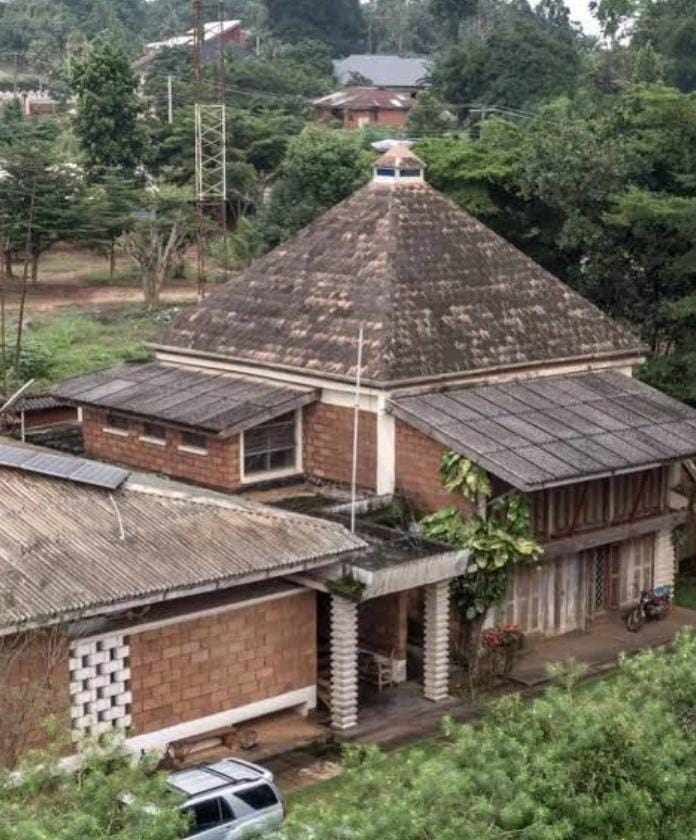
The pyramidal roof, topped with a raised cupola, lets hot air escape at the highest point.
The Ibadan house, completed in 1964, has reportedly never needed renovation or significant repair, according to published accounts of Nwoko's work.
The same accounts note that the unpainted bricks, made from laterite dug during excavation, vary in colour from ochre to rust, reflecting the layers of earth they came from. The building was designed to look better with age rather than worse.
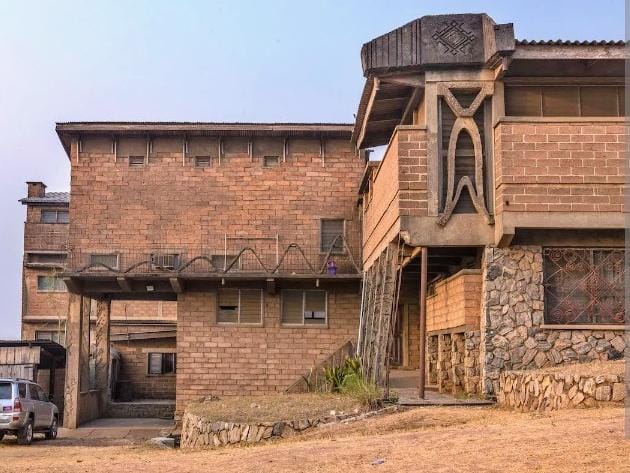
Unpainted laterite brick and stone: the colour shifts from ochre to rust with the earth it came from.
Why It Matters Now
The question is more than architectural. A 2019 doctoral study from the University of Strathclyde found that the built environment accounts for 44 percent of primary energy consumption in Nigeria, and that about 75 percent of that goes to air conditioning. Because of unreliable grid power, the same study reports that roughly 80 percent of households run their own generators, largely to keep cooling and food preservation going.
Cooling is one of the largest hidden costs of Nigerian housing, paid in fuel, electricity and generator maintenance.
There is supporting evidence from lower-income settings too. A recent Nigerian study reported by The Conversation found that residents of buildings made from adobe or compressed earth blocks enjoyed better comfort than those in makeshift metal or plastic structures, and that cross-ventilation and shading did much of the work.
The Caveats
The post presents the idea as the story of a single remarkable home, and that framing needs care. The documented record centres on Nwoko's Ibadan house, and the 95-degree claim in the video could not be independently verified. A design that works on one site, in one climate, with one architect supervising it, does not automatically transfer to every plot in the country.
Even sympathetic research is cautious. The Strathclyde study, which focused on the warm, humid south-east, concluded that earth-based building needed added techniques, including ground pipe ventilation and night-sky radiant cooling, to displace around 83.5 percent of air conditioning energy demand. In other words, passive design reduces the cooling burden sharply, but good engineering still matters.
Scale is the harder problem. The Al Jazeera profile observes that most Nigerians now live in their own version of the colonial-style house, built from concrete blocks with large windows that invite heat and demand fans and air conditioners in every room. Cement is cheap and familiar, lenders and buyers tend to trust it, and mud construction still carries a social stigma that has little to do with performance. Those are cultural and market barriers, not engineering ones.
The Takeaway
The lesson is not that Nigerians should return to mud. It is that cooling is a design decision made before the first block is laid, and that Nigerian architects such as Nwoko have been proving for decades that climate-responsive building is possible. For a country that spends heavily on generator fuel just to stay comfortable, the question is far from academic. Whether builders, regulators and homebuyers will follow is something the Instagram post cannot answer, and it deserves more attention than a viral clip can give it.
© 2026 Abdulmumin Ishola Olaleye | TalkAfricang.com

















Comments (0)
Leave a Comment